
To trace the Path of Rays of Light Through a Glass Prism
To trace the Path of Rays of Light Through a Glass Prism
Aim
To trace the path of rays of light through a glass prism for different angles of incidence, and to measure the angle of incidence (∠i), angle of emergence (∠e), angle of prism (∠A) and angle of deviation (∠δ).
Apparatus and Material Required
Drawing board, white sheet of paper, equilateral glass prism, drawing pins (or thumb pins), 4 office pins, sharp pencil, protractor, metre scale, and a set square.
Theory
- A glass prism is a transparent refracting medium with two triangular bases and three rectangular lateral faces. The angle between the two refracting faces is the angle of the prism (A).
- When a ray enters the prism, it bends towards the normal (air to glass). When it leaves, it bends away from the normal (glass to air).
- The emergent ray is therefore bent towards the base of the prism. The angle between the incident ray (extended) and the emergent ray is the angle of deviation (δ).
- Relation: δ = ∠i + ∠e − ∠A
- As ∠i increases, δ first decreases, reaches a minimum value, and then increases again. A graph of δ against ∠i is a U-shaped curve.
- Snell’s law: sin i / sin r = constant (refractive index of glass relative to air).
Ray Diagram
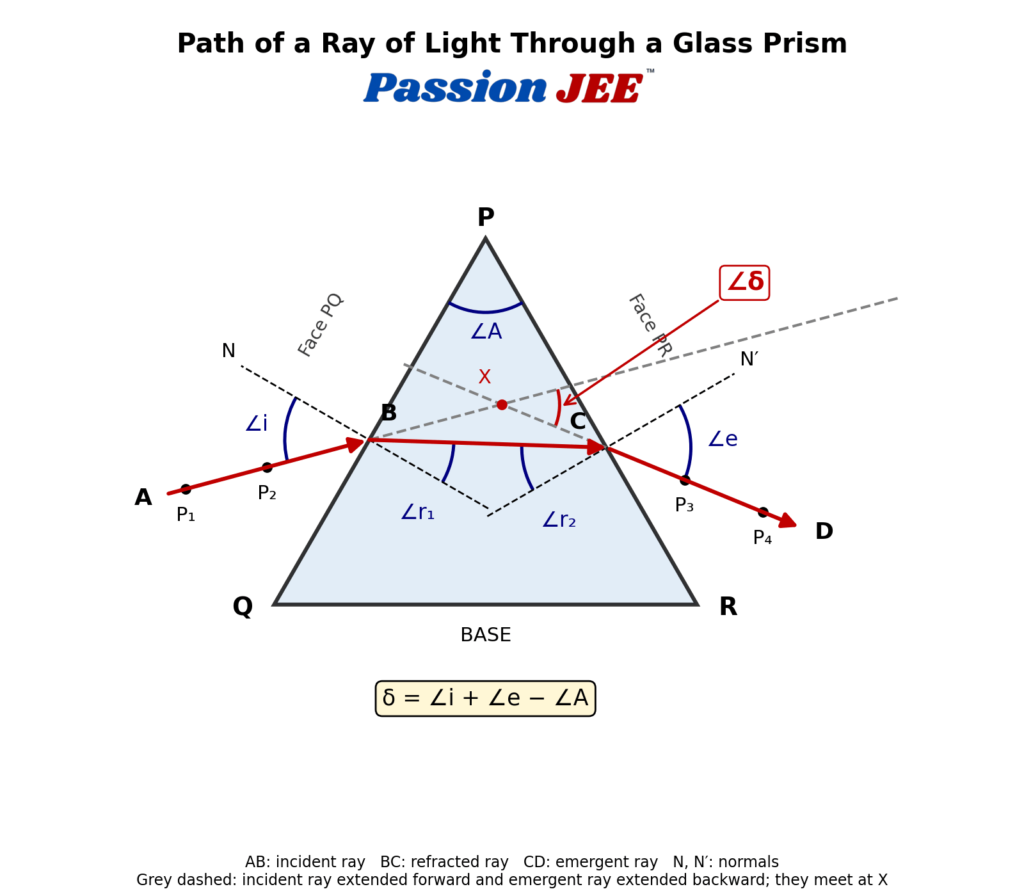
Procedure
- Fix a white sheet on the drawing board with drawing pins.
- Place the prism on the sheet with its triangular base down and draw its outline PQR with a sharp pencil. Remove the prism.
- Take a point B (near the middle) on face PQ and draw the normal at B.
- , Draw a line AB meeting it at point B and making a chosen angle (say 30°) with the normal. It acts as an incident ray Fix two pins, P₁ and P₂, vertically on this line, at least 5 cm apart.
- Replace the prism exactly on its outline.
- Look through face PR from the other side and move your eye until the images of P₁ and P₂ appear in one straight line.
- Fix two more pins, P₃ and P₄, so that they hide the images of P₁ and P₂ and appear in the same straight line.
- Remove the prism and the pins. Mark the pin holes with small circles.
- Join P₃ and P₄ and extend the line to meet face PR at point C. This is the emergent ray CD.
- Join B and C to get the refracted ray inside the prism.
- Draw the normal at C. Measure ∠i, ∠e and ∠A with the protractor.
- Extend the incident ray forward and the emergent ray backward. Measure the angle between them, which is ∠δ.
- Repeat with ∠i = 40°, 50°, 60° and 70° on fresh sheets.
Observations
Angle of prism, ∠A = 60°. Least count of protractor = 1°.
| S.N. | Angle of incidence ∠i (°) | Angle of emergence ∠e (°) | Angle of deviation ∠δ measured (°) | δ = i + e − A (°) |
|---|---|---|---|---|
| 1. | 30 | 77 | 47 | 47 |
| 2. | 40 | 59 | 39 | 39 |
| 3. | 50 | 47 | 37 | 37 |
| 4. | 60 | 39 | 39 | 39 |
Results
- The ray bends towards the normal on entering the prism and away from the normal on emerging.
- The emergent ray is deviated towards the base of the prism.
- The measured values of δ agree with δ = i + e − A.
- The angle of deviation first decreases and then increases as ∠i increases. Its minimum value here is about 37°, near ∠i = 50°.
Precautions
- Fix the paper firmly and use a sharp pencil for thin, precise lines.
- Keep the pins vertical and at least 5 cm apart.
- Always trace the prism outline carefully and replace it exactly on the outline.
- Keep the angle of incidence between about 30° and 60° for clear observations.
- View the pin images from the same level, close to the paper.
- Make the pin-hole marks small, and use the same pinhead tips for alignment.
- Handle the prism by its lateral edges, and never touch the polished refracting faces.
- Measure all angles from the normal, not from the surface.
Sources of Error
- Pins not perfectly vertical or not exactly in line.
- Prism not replaced exactly on its outline.
- Parallax while aligning the pin images.
- Thick pencil lines or protractor reading errors.
Viva questions on Refraction through Prism, Click Here
For more practical records in Science Practical Class 10, Click here
For more practical records in Practical Records for Class 11, Click here
For more practical records in Physics Practical Class 12, Click here
For Viva questions on Physics Practical Class 12, Click here